

In this article we are going to take a close look at three primal Hebrew words. We will start with the Hebrew word for god אֵל (el), then move to the word כֵּן (ken) which basically means yes, and end with the word חֵטְא (chet) which is the Hebrew noun for sin. For each word, we will not only try to understand its root but also examine other related words that also stem from it, but also see what underlying symbolic value they might have, and how ancient Hebrew speakers oriented themselves in questions of faith and morality.
The Hebrew word for god
The common word for god in Hebrew is אֵל (pronounced el) and note that it may refer to any god and not only to the God of the Bible. We have already discussed this word and its origin in the first post of Hebrew Monk’s Substack about the letter א (alef) – the first letter in the Hebrew alphabet:

I don’t see the point of writing it all here again, so instead I’ll just give you the gist. While the origin of the word אֵל (god) is uncertain, most Hebrew scholars believe that the word originally meant power or force, and that it is quite possibly related to the word אַיִל (a’yil) meaning a ram - an animal which also symbolizes power. The primal two-letter root א-ל is also found in later three-letter roots which also relate to power such as the root א-ל-צ which means to force or to compel, the root א-ל-מ which signifies violence, and the root א-ל-פ which relates to champions and leadership.
This relation to power and ram is a perfectly reasonable explanation for the Hebrew word for god אֵל (el), and there’s probably more than some truth to it. However, one also simply cannot ignore the resemblance between the word אֵל and another fundamental Hebrew word – the preposition אֶל (el) which means towards. They are written with the same two letters, and the only difference is that in אֵל (god) there’s a tzere under the Alef, while in אֶל (towards) there’s a segol, but both of these niqqud signs stand for the vowel ‘e’ – one long (or big) and one short (or small) respectively.
This means that in Hebrew “god of something” also means being oriented towards that very same thing. Consequently, asking “what is your god” can also be understood as “what is your towards”, which is essentially the same as asking how do you orient yourself. When you think about it, this makes a lot of sense. Because when you worship something, you also face it and look up to it. Much like when you set something as your main goal or primary objective, it inevitably becomes the point you must move and strive towards.
As much as I like the association between these two words and the picture they paint together, I would probably still dismiss their resemblance as purely coincidental, if not two other Hebrew words that their etymology really resonates with this concept – the word כֵּן (ken) which means yes, and the word חֵטְא (chet) which means sin.
The Hebrew word for yes
The common way to say yes in Hebrew is the word כֵּן (ken), though this is a modern usage of the word. In Biblical Hebrew it more commonly meant ‘like so’ or ‘as such’, and by extension also ‘correct’ or ‘truth’. In case you’re wondering, the way to say yes in biblical Hebrew was the word הֵן (hen), but often people simply repeated the verb or the entire statement within the question as a form of acknowledgement.
The interesting thing about the Hebrew word כֵּן (yes) is its root and other related words that stem from it. The word כֵּן comes from the root כ-ו-ן (Kaf-Vav-Nun) and here is a list of words that are also based on it:
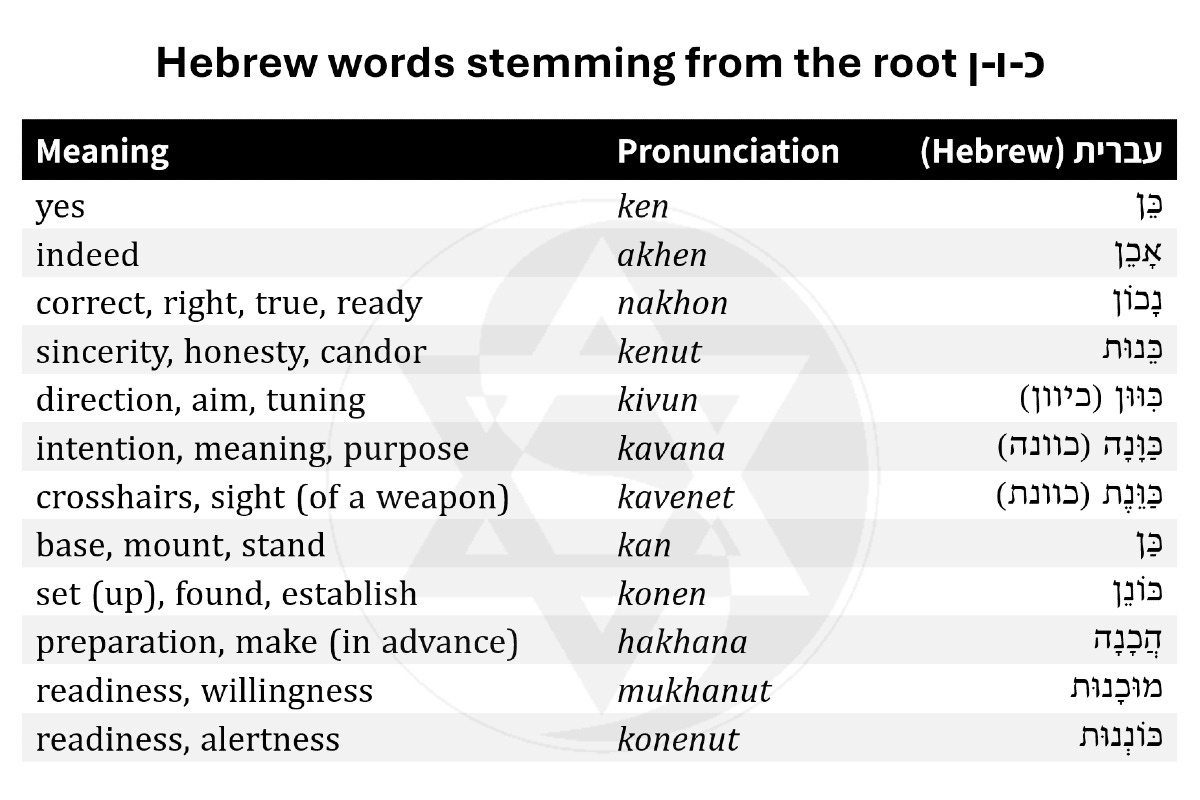
Looking at the list above, it’s quite easy to see that Hebrew draws a distinct etymological connection between the concepts of truth, direction, readiness, and even stability as indicated by the words כַּן (kan) and כּוֹנֵן (konen). If you are asking yourself how these two words relate to direction and readiness, there’s a good explanation for each of them. The word כַּן (kan) refers specifically to platforms that must face a certain direction when ready, for instance a pedestal, a launch pad (כן שיגור) or an easel (כן ציור). The verb כּוֹנֵן (konen), apart from referring to founding a new body and setting its course, may also describe nocking an arrow onto a bow (see Psalms 11:2).
The root כ-ו-ן along with many of its derivative words revolve around the concept of aim, and that goes hand in hand with the preposition אֶל (towards) we discussed in the previous section of this article. But it also serves as a nice reminder that no matter what your “towards” is, aiming for takes more than just facing the right direction. It is also a question of timing, preparation and readiness, and of will, intentions, truth and sincerity. Only when all those terms are met are we able to hit our target and reach our goal.
It is worth noting that this association between direction and correctness is not unique to Hebrew. In English we have the word ‘right’ which is the opposite of both left and of wrong, and in Chinese we have the character 對 (duì – written 对 in simplified Chinese) which means both ‘correct’ or ‘right’ and ‘facing’ or ‘in front of’. Also note that the word ‘correct’ itself consists of the prefix ‘con’ meaning together and the root ‘regere’ which refers to moving in a straight line.
However, unlike English and Chinese, Hebrew didn’t arbitrarily choose one specific direction to convey the meaning of correct and instead went with the general idea of aiming well. Now let’s see what happens when we aim wrong.
The Hebrew word for sin
The last and most important piece of our puzzle today is how Hebrew conceptualizes the idea of sin. The Hebrew noun for sin is חֵטְא (chet) and the Hebrew verb for sin חָטָא (chata) are based on the root ח-ט-א (Chet-Tet-Alef). However, the original meaning of this root had nothing to do with sin at all, and instead it simply meant to miss in the sense of not hitting the target. This ancient meaning is still preserved in the Hebrew verb הֶחֱטִיא (hecheti) and its corresponding noun הַחְטָאָה (hachta’a) which can mean both ‘to miss the target’ and ‘to cause others to sin’.
It is interesting to note that the root ח-ט-א is also one of those rare instances Hebrew employs the same root to express opposite meanings. Because when we conjugate it in the Pi’el structure, we get the verb חִטֵּא (chite) which means to sanitize, disinfect or sterilize in the sense of cleansing something thoroughly. In biblical Hebrew it refers to ritualistic purification and the washing away of sins. In modern Hebrew it usually appears in the context of medicine and hygiene, and you can imagine just how its usage rate grew since 2020.
The Lord is my Shepherd
So what does all this say about the origin of the Hebrew word for god? Well, I honestly don’t know. On the one hand, the relation between the word אֵל (god) and the idea of power has a strong case, and the connection to the word אַיִל (a’yil – ram) also makes a lot of sense. On the other hand, the root כ-ו-ן and its relation to both direction and truth, and even more so the root ח-ט-א and its relation both to miss and sin, do indicate that Hebrew theo-linguistically associate worship with aiming.
But maybe we don’t have to choose. What if the word אַיִל (a’yil) is the inspiration not only for ‘god’ and ‘force’, but also to the idea of ‘towards’? After all, from a shepherd’s perspective the ram determines where the rest of the flock goes. And from a hunter perspective, a ram is certainly a prime target to aim at. Furthermore, if you miss your shot or throw, one could argue you have wronged your hunting crew and possibly the entire the tribe.
Speaking of hunting and targeting desired animals, it is also worth noting that the word חֵטְא (sin) was also written חֵט without the Alef at the end. When written like this it looks very similar to the word חָט (chat) which means tusk. The only animal in Canaan and the Levant that bore tusks was the wild boar – which was considered unclean by the ancient Hebrew tribes and eating it eat was in fact a sin. As cool as it sounds, this is probably just a coincidence, as the word חָט (chat) most likely stems from a primal root expressing sharpness which also gave us words like חָד (chad – sharp), חֶץ (chets – arrow), and possibly even עֵט (et – pen).
The bottom line is there is no way of knowing what’s behind this holy trinity of associations between the concepts of god and towards, true and aim, and sin and miss. But even if there’s nothing behind it and it’s all just a big coincidence, they still paint a very intriguing and inspirational picture.
When I think about a possible link between these three concepts, two movie-related thoughts pop into my head. The first is Private Jackson, the sniper from Saving Private Ryan who used to pray as he was shooting:
The second is Galadriel’s words she greets the fellowship after they entered Lothlorien in the first Lord of the Rings movie, and specifically the words she utters when she turns to look at Sam: “Yet hope remains while the company is true”.
I have always liked this scene and thought it was very subtle yet powerful hint to the value and nature of Sam’s character and how essential his presence is to the fellowship. But now that line (the word “true” in particular) echoes differently after the warning of “stray but a little and it will fail to the ruin of all”.
So there you have it. Even Tolkien made that link between truth and walking in the right direction. I think it’s time to read The Lord of the Rings again…